The most useful AI HUD smart glasses in 2026 are not miniature VR headsets. They put short pieces of information into a normal line of sight: a message, live captions, walking directions, a teleprompter line, a meeting prompt, or an AI response. The five products here solve that job in sharply different ways, from Meta’s camera-and-display system to camera-free glasses built for privacy or work.
The important split is not simply which pair has the brightest screen. It is whether the display is monocular or binocular, whether the glasses include a camera, whether audio is built in, how long the battery lasts, and whether the product can be purchased like a normal consumer device. Those differences decide which pair will actually fit daily life.
Meta Ray-Ban Display is the strongest consumer package. Even G2 is the cleanest camera-free daily HUD. Halo is the most attractive open-source platform. Halliday G2 is the meeting specialist. Vuzix Z100 makes the most sense for work and custom workflows.
AI HUD smart glasses compared
| Product | U.S. price context | Display | Sensors and audio | Battery | Best for | Main catch |
|---|---|---|---|---|---|---|
| Meta Ray-Ban Display | $799, glasses and Neural Band | Private full-color in-lens display | Camera, microphones, open-ear audio | Up to 6 hours; case up to 30 total | Best all-around consumer system | Highest price and shortest listed glasses battery |
| Brilliant Labs Halo | $349 | Color display | Low-power optical sensor, dual microphones, bone-conduction audio | Up to 14 hours | Best for open-source builders | Noa+ costs $19.99 per month after free daily limits |
| Even Realities G2 | $599 | Binocular green microLED, 640×350, 27.5 degrees | Four microphones; no camera or speaker | Typical 2 days; case adds 7 recharges | Best camera-free everyday HUD | No open-ear audio and no visual camera AI |
| Halliday G2 | $599 MSRP; current priority price starts at $499 | Binocular green microLED, 600×300 per eye, 25.2 degrees | Four microphones and four directional speakers; no camera | Up to 12 hours | Best meeting-first option | Reservation-stage purchase and membership tiers require scrutiny |
| Vuzix Z100 | $499 at 2024 general availability; current sales path should be confirmed | Right-eye green microLED, 640×480, 30 degrees | No camera; phone-connected HUD | Up to 48 hours | Best for work and custom workflows | Less polished as a mainstream consumer purchase |
Prices above are official U.S. list or launch figures, not promises about today’s inventory. Halliday G2 is presented through a reservation and priority-access path. Vuzix announced Z100 general availability at $499 in November 2024, but its current site emphasizes sales contact and volume deployment. Buyers should confirm stock, return terms, prescription options, and any required membership before paying.
Meta Ray-Ban Display is the strongest consumer system
Meta Ray-Ban Display starts at $799 and includes both the glasses and Meta Neural Band. Its private full-color in-lens display can show messages, photo previews, visual Meta AI responses, live captions, translations, walking directions, and music controls. The wristband reads subtle muscle signals for gestures, which gives Meta a control method that does not require constant voice commands or conspicuous temple tapping.
It is also the only product in this group that combines a display with Meta’s established camera-glasses stack. That means first-person capture, microphones, open-ear speakers, messaging, and visual AI belong to one mainstream product rather than a developer kit. The tradeoff is equally clear: $799 is the highest entry price here, and Meta lists up to six hours of mixed use for the glasses, with the case extending total use to 30 hours.
Choose Meta when camera capture, audio, visual AI, navigation, and mainstream retail support all matter. Avoid treating it as a private cinema or a Meta Quest replacement. The display is designed for brief interactions, not hours of immersive entertainment. The full Meta Ray-Ban Display guide provides the deeper product breakdown.
Even G2 makes privacy part of the product

Even Realities G2 takes the opposite route. It has no camera and no speaker. A binocular green microLED waveguide display puts the same 640×350 interface in both eyes across a 27.5-degree field of view, while four microphones support voice input. The official specification lists 60Hz refresh, up to 1,200 nits, 98 percent passthrough, IP65 protection, Bluetooth Low Energy, typical two-day battery life, and seven additional recharges from the case.
That design gives up visual AI and open-ear audio, but it reduces the social tension that follows camera glasses. Live translation, notes, prompts, navigation cues, and teleprompter-style text can sit in view without making people wonder whether they are being recorded. Prescription support also makes G2 a more credible all-day pair than a display accessory worn only for media.
At $599, Even G2 is not the budget choice. Its value depends on wanting a calm binocular HUD more than capture or audio. Choose it when privacy, battery endurance, and discreet daily information matter more than taking photos. The Even G2 guide covers the camera-free experience in greater depth.
Brilliant Labs Halo is the open-source choice
Brilliant Labs lists Halo at $349, making it the least expensive product in this five-way comparison. The glasses weigh just over 40 grams and combine a color display, a low-power optical sensor, two microphones, two bone-conduction speakers, Bluetooth 5.3, an Alif B1 processor, and the open-source ZephyrOS platform. Brilliant Labs lists up to 14 hours of battery life and offers prescription and sunglass configurations, including adjustable diopter support from +2 to -6.
Halo’s advantage is not that it beats Meta at mainstream polish. It is that developers can inspect, modify, and build around the platform. Noa AI supplies the consumer assistant layer, while the open hardware and software direction makes Halo more interesting for experiments, prototypes, personal agents, and people who dislike closed wearable ecosystems.
The cost needs one qualifier. Free Noa use has daily limits, while Noa+ is listed at $19.99 per month. Buyers should include that possible subscription in the real ownership cost. Halo is the best fit for builders and early adopters who value openness; it is less certain for someone who simply wants the most polished retail experience.
Official Brilliant Labs Halo video via Brilliant Labs.
The full Brilliant Labs Halo guide explains Halo’s hardware, Noa AI, prescription options, and open-source positioning.
Halliday G2 is built around meetings

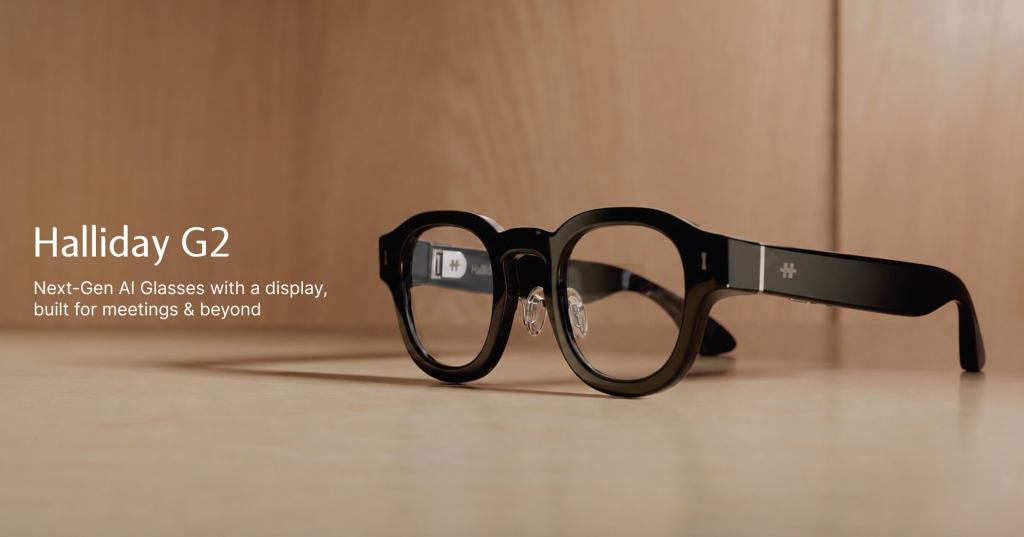
Halliday G2 is a camera-free, meeting-first design with binocular green microLED waveguides. Halliday lists 600×300 resolution per eye, a 25.2-degree field of view, up to 1,600 nits, four microphones, four directional speakers, IP54 protection, and up to 12 hours of battery life. Prescription support covers sphere values from -8 to +2 and cylinder values from -2 to 0.
The combination of display, microphones, and speakers makes Halliday broader than Even G2 for calls and meeting assistance. Its product pitch centers on live translation, notifications, schedules, meeting prompts, and a personal dashboard rather than photos or entertainment. The missing camera can be an advantage in offices where capture glasses would create discomfort.
Halliday lists a $599 MSRP and a current priority-access price starting at $499, but the purchase path is still reservation-oriented. The service model also includes Basic, Pro, and Max membership tiers, with Basic included for the first year under the current offer. That means the correct question is not only whether the hardware looks useful. Buyers must also decide whether the future membership cost and pre-retail status fit their tolerance for risk.
Vuzix Z100 is the work and workflow specialist

Vuzix Z100 weighs 38 grams and uses a right-eye monochrome green microLED waveguide display with 640×480 resolution and a 30-degree field of view. Vuzix lists up to 48 hours of operation, Bluetooth Low Energy, temple-tap control, prescription-ready support, and Android and iOS development tools. The display can surface notifications, messages, teleprompter text, fitness metrics, navigation cues, and custom workflow data.
Its strongest case is not lifestyle AI. It is quiet information at work. A warehouse, field-service, healthcare, logistics, or training application can push one useful instruction into view without giving the worker a full headset. The lack of a camera also simplifies deployment in some sensitive environments.
Vuzix announced general availability at $499 in November 2024. The current sales path should still be checked because Vuzix now emphasizes contact-based and volume purchasing more than a conventional consumer checkout. Choose Z100 when software integration and long battery life matter more than mass-market style. The Vuzix Z100 guide provides the longer workflow-focused analysis.
Monocular versus binocular changes comfort and purpose
Even G2 and Halliday G2 use binocular displays, so both eyes receive the interface. That can make text feel more centered and natural for repeated glances. Vuzix Z100 uses a right-eye display, which keeps the system efficient and leaves the other eye unobstructed, but some wearers need time to adapt. Meta’s private in-lens display and Halo’s compact color display sit between those philosophies, prioritizing glanceable information rather than a wide spatial canvas.
None of these products should be chosen primarily for movies, PC gaming, or console play. XREAL, VITURE, RayNeo, and Rokid display glasses use a different optical and input model built around a large virtual screen. Readers who want entertainment should use the AR display glasses comparison instead.
Camera, audio, and privacy are the real dividing lines
Meta combines camera, display, microphones, and speakers, giving it the widest consumer feature set and the greatest privacy responsibility. Halo includes an optical sensor and audio, but its developer-first identity is different from Meta’s social camera ecosystem. Even G2 removes both camera and speaker. Halliday removes the camera but keeps directional audio. Vuzix removes the camera and focuses on phone-fed or app-fed information.
For a buyer who spends the day in meetings, clinics, schools, or offices, camera-free hardware can be more useful precisely because it attracts less suspicion. For travel, family capture, visual AI, and hands-free photography, Meta’s camera is the advantage. Product choice should follow the environment rather than the longest feature list.
Prescription support and availability can overturn the spec sheet
Smart glasses fail when they cannot replace the pair already needed for vision. Halo, Even G2, Halliday G2, and Vuzix Z100 all present prescription paths, but the ranges, lens process, region, and fulfillment model differ. Meta also offers prescription-compatible configurations through its retail ecosystem. Buyers should verify their exact prescription, pupillary distance needs, return policy, and local fitting support before choosing a display specification.
Availability deserves equal weight. Meta has the clearest mainstream retail proposition. Even G2 and Halo are direct consumer products, but stock and regional fulfillment can change. Halliday G2 remains tied to reservation and priority access. Vuzix increasingly speaks to organizations and volume buyers. A technically superior pair is a poor purchase if warranty service, replacement lenses, or returns are unclear.
Which AI HUD smart glasses should you buy?
- Buy Meta Ray-Ban Display for the strongest all-around combination of camera, audio, visual AI, controls, and retail support.
- Buy Even G2 for a discreet binocular HUD with no camera, long battery life, and a calmer social profile.
- Buy Brilliant Labs Halo if open-source access and building new AI eyewear experiences matter more than mainstream polish.
- Consider Halliday G2 for meetings, translation, prompts, and directional audio, but only if reservation and membership terms are acceptable.
- Choose Vuzix Z100 for enterprise workflows, custom apps, long battery life, and a camera-free monocular display.
Most buyers who are still unsure should begin with the overall smart glasses buying guide and the smart glasses types explainer. Those pages separate camera glasses, HUD glasses, and entertainment display glasses before price or brand loyalty takes over the decision.
Official sources
- Meta: Meta Ray-Ban Display and Neural Band announcement
- Brilliant Labs: Halo product and specification page
- Even Realities: Even G2 specifications
- Even Realities: developer documentation and hardware limits
- Halliday: Halliday G2 product, price, and membership details
- Vuzix: Z100 general-availability announcement