quick answer for shooting-sim readers
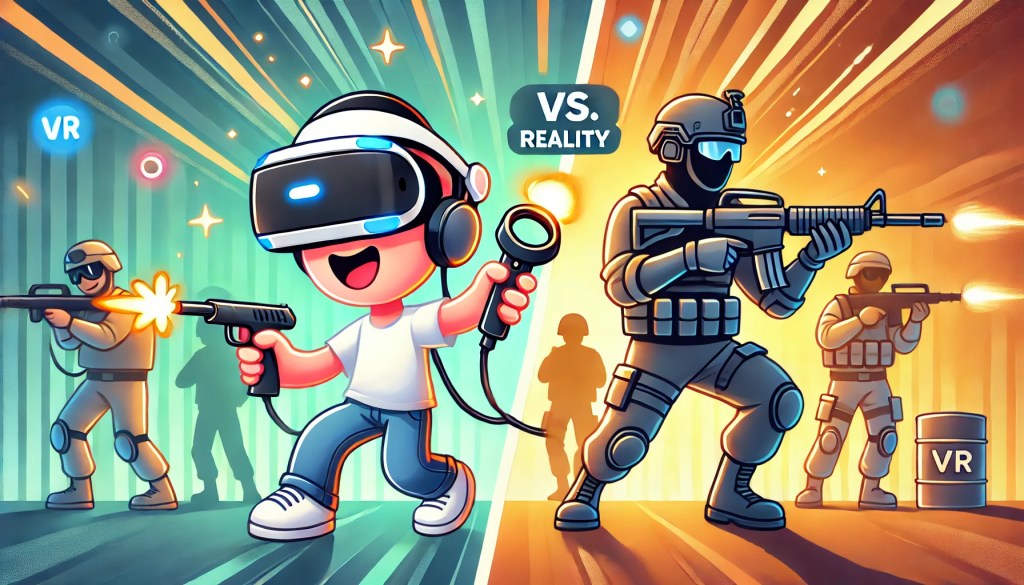
VR shooting can teach sight alignment, hand positioning, weapon handling concepts, and scenario awareness, but it is not the same as firing a real gun. Real firearms add recoil, blast, weight, legal safety rules, and stress that a headset cannot fully reproduce. Treat VR as a training-style simulation or game, not as real firearms experience.
Have you ever wondered how realistic shooting a gun in Virtual Reality(VR) is compared to real life? As someone who has undergone mandatory military service, I’ve had hands-on experience with real firearms. Unlike in video games, hitting a target is much harder than it looks. Your breathing, stance, and even small movements can significantly impact accuracy.
After playing various VR shooting games, I realized that while VR shooting is easier in many ways, it also has its own unique challenges. There’s no recoil, and the controllers are much lighter than real guns. If you assume that being a good shooter in reality means you’ll be great in VR, think again! VR shooting has its own mechanics that require adaptation. Read on for a breakdown of key differences. And if you haven’t tried VR yet, I highly recommend getting a headset. Use my referral link below when purchasing a Meta Quest to receive credit for both of us! 👉 Meta Quest Referral Link
1. Aiming: Aligning the Sights 🎯
In both reality and VR, aiming is done by aligning the front sight and rear sight of the gun. However, differences arise depending on the type of firearm and shooting stance.
- Handguns: In reality, you extend your arms and keep the gun at a distance, using your dominant eye to focus on the sights.
- Rifles: You shoulder the gun and bring your dominant eye close to the rear sight.
The problem in VR? When shouldering a rifle, the virtual gun often disappears from view because the controller is positioned too close to the headset’s field of vision. This forces players to hold rifles farther from their bodies, similar to handguns. Another major difference is that VR allows both eyes to remain open without causing double vision or depth perception issues, unlike in real life. Interestingly, even if you shoulder a rifle on your right side and close your right eye, you can still aim effectively with your left eye. However, just like in reality, the focal point shifts slightly when using one eye versus both. Based on my experience, it’s best to either always use both eyes or consistently rely on your dominant eye, regardless of gun positioning.
Not sure which eye is dominant? Try this simple test: Form a circle with your thumb and index finger and look at a distant object through it. Close one eye at a time. The eye that keeps the object centered within the circle is your dominant eye. This can be useful knowledge for improving your VR aiming skills!
2. Reloading: Manual vs. Automatic 🔄
Have you ever reloaded a real gun? In reality, you:
- Press a button to eject the empty magazine.
- Insert a new magazine.
- Pull the slide or charging handle to chamber a round.
VR offers two types of reloading:
- Manual Reloading: This method closely replicates real-world firearm handling, requiring you to manually eject the magazine, insert a new one, and rack the slide or charging handle. While it’s more forgiving than reality in terms of precision, it still demands practice and muscle memory to perform quickly and efficiently, especially in high-pressure situations.
- Automatic Reloading: Simply flick the controller downward, and the gun reloads instantly. Some games allow you to reload by moving your controller to a virtual ammo belt.
If you just want to enjoy shooting, automatic reloads are perfect. But for added realism and excitement, try manual mode. I personally love playing Arizona Sunshine 2 with manual reloading—it’s nerve-wracking when zombies are closing in! Check out my shooting clips on Instagram: 👉 VR Shooting Clips
3. Reloading Different Gun Types 🔫
Unlike traditional console shooters, VR games often differentiate reloading methods based on gun type:
- Semi-Automatic Pistols: Eject the magazine by pressing a button on the controller, grab a new magazine using the other controller, insert it, and rack the slide by swiping or pressing a secondary button.
- Rifles & SMGs: Similar to pistols, but the charging handle is on the side, requiring more precise hand positioning. Typically, you use the non-dominant controller to pull the handle back before firing.
- Revolvers: Open the cylinder by pressing a button, tilt the controller to remove empty shells, grab new rounds and place them in manually, then flick your wrist to snap the cylinder shut.
- Shotguns: To reload, first press the button on your controller to break open the barrel by moving it downward. You will see the spent shells automatically eject. Next, use your non-dominant controller to grab new shells from your ammo belt or designated area, then manually insert them one by one into the chamber. Once all shells are loaded, flick the controller back up to snap the barrel into place. Some VR games require an extra pumping motion to chamber the next round. This process can feel cumbersome, but it adds a satisfying layer of realism to shotgun gameplay.
Each type offers a distinct experience, making VR shooting incredibly immersive.
4. Impact & Feedback: Visuals vs. Recoil 🔊💥
Real firearms have two major sensory impacts:
- Sound: Gunshots are deafening, and shooting without ear protection can be painful.
- Recoil: The force against your shoulder or hands can leave bruises if not handled correctly.
VR, on the other hand, focuses on visual and auditory effects rather than physical feedback. Since VR utilizes a 360-degree display, it enhances immersion by emphasizing visual elements like muzzle flashes, bullet impacts, and environmental destruction, making up for the lack of real recoil and weight. Gunfire sounds are often toned down, but impacts on objects or enemies are exaggerated. This emphasis on visuals is intentional, as VR lacks the physical sensation of recoil and weight, making it crucial to enhance engagement through more dramatic animations and effects. Blood effects, sparks, and physics-based destruction make every shot feel powerful, compensating for the missing tactile feedback.
5. Weapon Switching: Inventory vs. Holstering 🏃♂️
VR strikes a balance between real-life weapon handling and traditional gaming inventory systems:
- Menu-Based Switching: Similar to PC or console games—pause, select a weapon, and resume play.
- Holster-Based Switching: More realistic—physically reach for your sidearm, rifle, or grenades at designated locations on your body (hips, back, etc.).
Holster-based switching enhances immersion but limits the number of weapons you can carry at once.
Final Thoughts: Realism vs. Fun
There’s a trade-off between realism and enjoyment in VR shooting. More complex reloading and aiming mechanics make for a richer experience, but they also add difficulty. For instance, revolvers and shotguns require more effort but provide greater satisfaction when fired.
If you’re expecting a 1:1 replication of real-world shooting, you might be disappointed. However, if you’re looking for a thrilling and immersive shooting adventure, VR is unbeatable! I highly recommend giving it a try.
Thinking of getting a Meta Quest? Use my referral link to grab some credit for both of us! 👉 Meta Quest Referral Link
And don’t forget to check out my shooting clips on Instagram: 👉 VR Shooting Clips
Happy shooting! 🔫🎮
Continue Reading
Stay in the VR guide loop with these related PlayTechDeep articles.
- Best VR Games in 2026: The Essential Meta Quest GuideAn evergreen guide to the best VR games in 2026 for Meta Quest owners, covering beginners, fitness, co-op…
- Ghosts of Tabor on Meta Quest: Is This Extraction Shooter Worth the Risk?Ghosts of Tabor on Meta Quest: a U.S.-focused app guide covering price, extraction gameplay, loadouts, raid…
- Moss on Meta Quest: Why It Still Feels Like VR’s Warmest Storybook AdventureA detailed U.S.-focused guide to Moss on Meta Quest, covering price context, how it plays, community response…
- Walkabout Mini Golf on Meta Quest: Why It Still Feels Like VR’s Easiest RecommendationA detailed U.S.-focused guide to Walkabout Mini Golf on Meta Quest, including price context, how it plays, why…