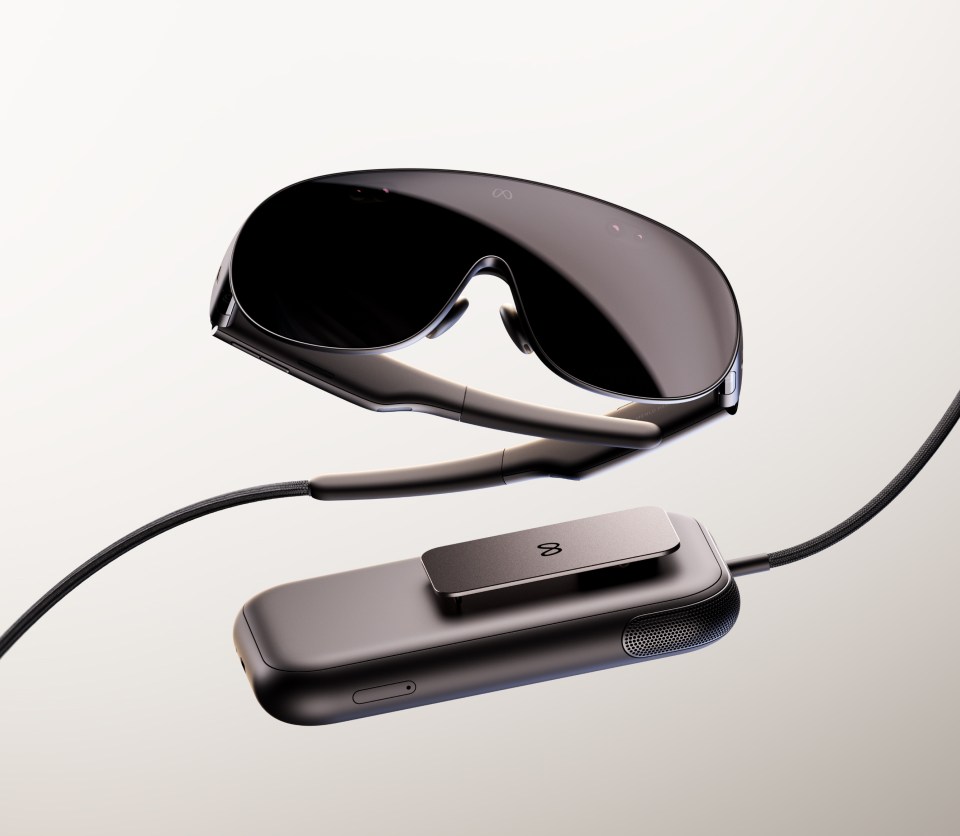

Assassin’s Creed Nexus VR is the kind of Meta Quest app that sounds impossible until you actually see why it exists. Assassin’s Creed has always been about rooftops, crowds, ledges, blades, timing, and that reckless little voice that says one more climb before the mission ends. Nexus VR takes that fantasy and asks a simple question: what if the leap, the climb, the hidden blade, and the air assassination were no longer camera moves, but body moves?
That is why this still deserves a standalone app guide. It is not merely a brand-name spin-off. It is one of the clearest attempts to turn a major flat-screen franchise into a full VR action-adventure, with enough scale, comfort options, and fan-service value to matter for U.S. Quest buyers who want something larger than a tech demo.
Meta Quest referral
If you use this link when buying a Meta Quest headset, you can receive a $30 store credit. Only use it if it feels useful.
Quick Buyer Snapshot
- Genre: first-person VR action-adventure built around parkour, stealth, melee combat, ranged tools, and mission-based exploration.
- Developer / publisher: Ubisoft, with Red Storm and multiple Ubisoft studios involved.
- U.S. price context: $39.99 in current U.S. public store snapshots. Confirm the live Meta price before buying because sales and bundles can change.
- Best for: Assassin’s Creed fans, players who want physical climbing and stealth, and Quest owners looking for a bigger single-player adventure.
- Play mode: single-player.
- Comfort context: VRDB lists the comfort level as Comfortable, and Ubisoft highlights options such as peripheral vision blocking and teleportation.
- Headset support: Meta lists support for Quest 2, Quest Pro, Quest 3, Quest 3S.
Why This Is Still Worth Covering
Nexus VR stands out because it understands what Assassin’s Creed fans actually want to feel. The fantasy is not only stabbing guards. It is approaching a location from above, reading patrol routes, blending into a crowd, climbing out of trouble, and turning height into power. Ubisoft’s official page frames the game around open maps, 360-degree navigation, stealth, social blending, combat, historical figures, and comfort settings. That is the right checklist for this franchise.
The game also uses three familiar assassins: Ezio Auditore, Kassandra, and Connor. That structure is not subtle fan service, but it works because each hero lets the game change texture. Ezio brings the classic hidden-blade fantasy, Kassandra gives the Greek-era warrior energy, and Connor adds tomahawk-and-bow physicality. The result feels more like a curated Assassin’s Creed VR anthology than a single new mainline entry.
How It Plays on Quest
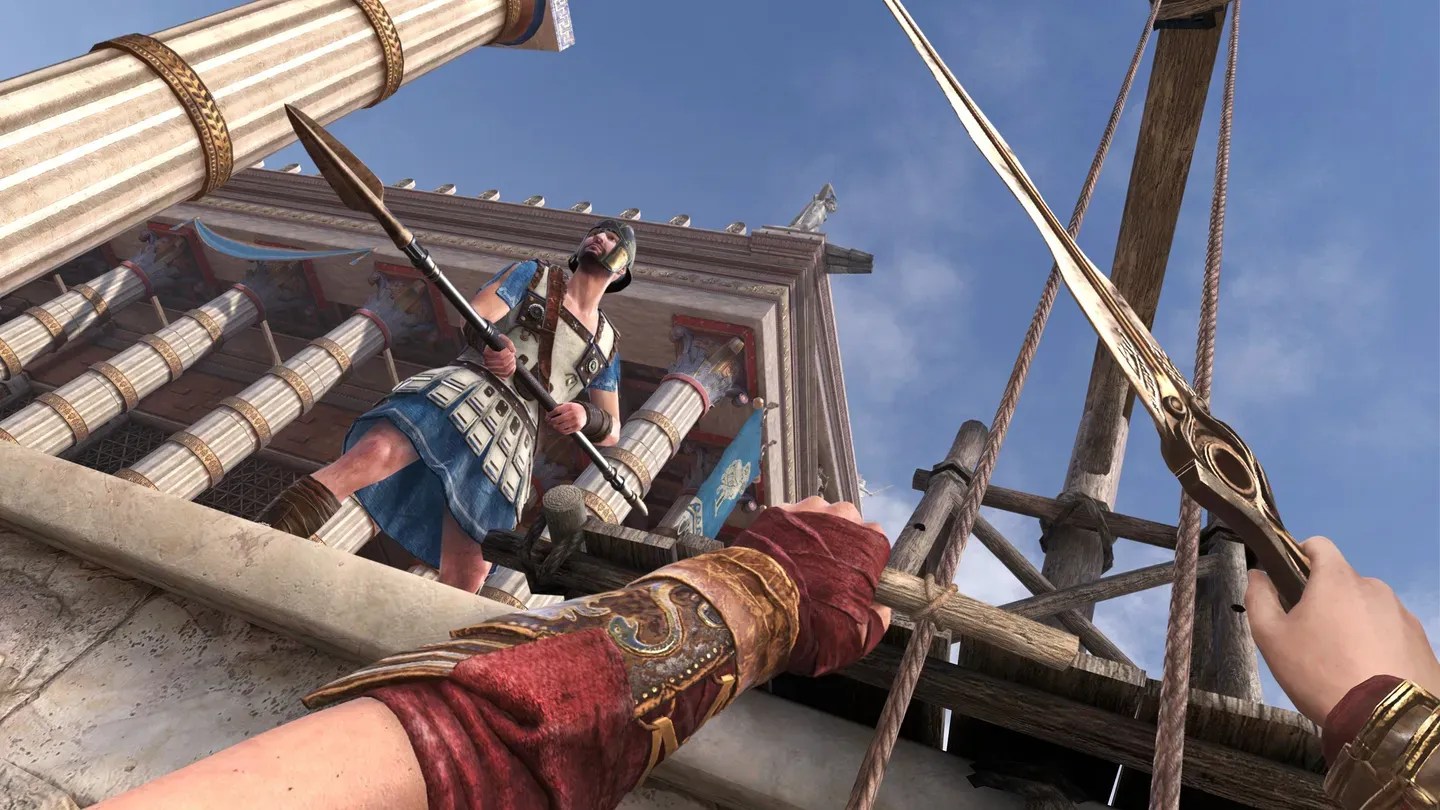
The basic loop is mission-based stealth action. You enter a historical space, scout routes, climb, parkour, hide, distract enemies, use tools, fight when things go wrong, and complete objectives with some freedom in how you approach them. The important part is that movement is not just a way to get from marker to marker. Movement is the app’s main argument.
UploadVR’s gameplay-trailer coverage pointed to exactly the systems buyers care about: parkouring between buildings, bow-and-arrow play, throwing knives, hidden passages, rowing, air assassinations, and multiple eras tied to Kassandra, Ezio, and Connor. In practice, that means Nexus VR is not one tiny mechanic stretched into a full price. It is a stack of Assassin’s Creed verbs translated into VR.
Why Parkour Is the Real Hook
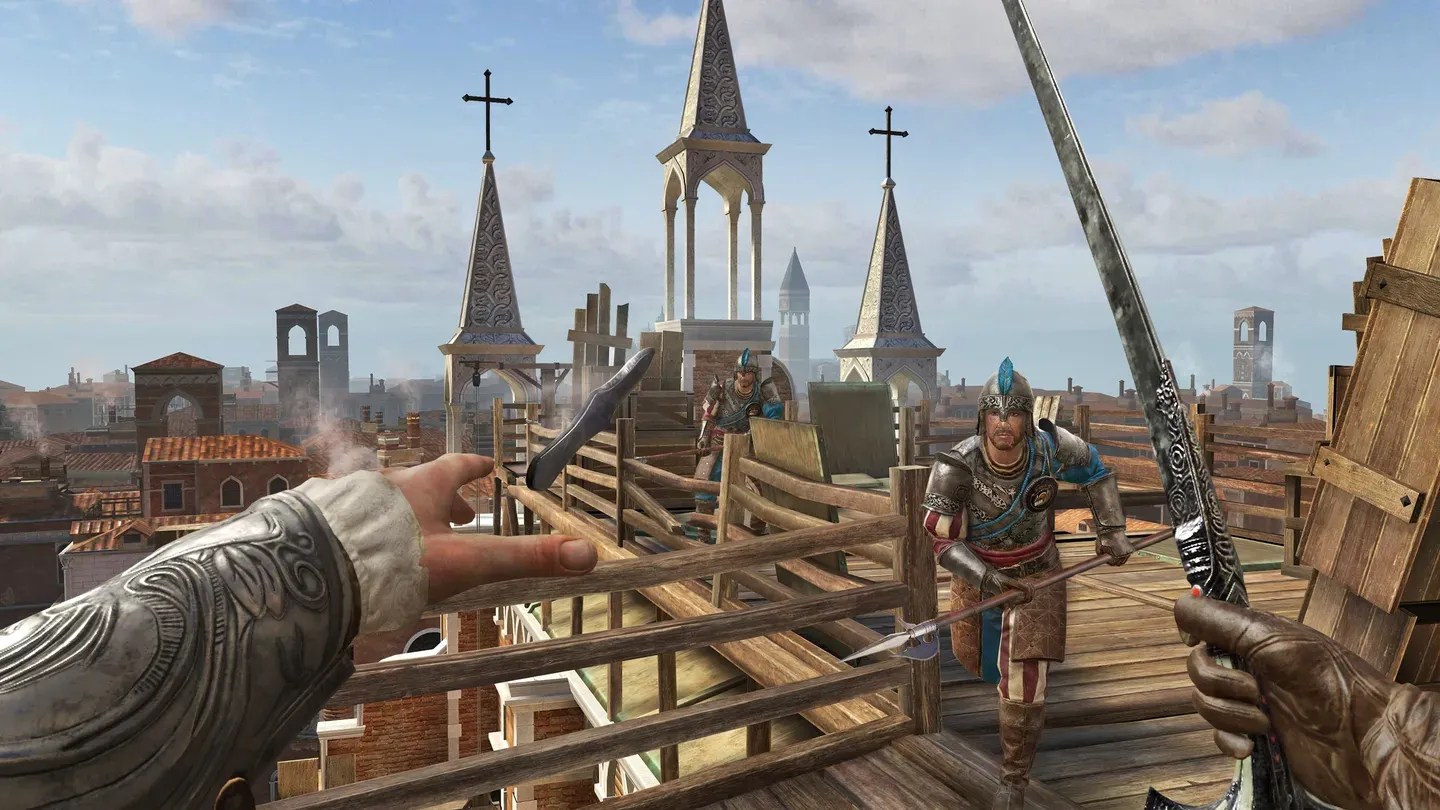
Parkour is the reason to buy Nexus VR. Climbing in VR has a tactile quality that flat-screen Assassin’s Creed can only imply. You reach, grab, pull, look down, decide whether to jump, and suddenly the old series language becomes more personal. A rooftop is not just a path; it is a place your arms and stomach understand.
This is also where comfort matters. Ubisoft built in mitigation tools for nausea, vertigo, and fear of heights, and that should not be treated as a footnote. A VR Assassin’s Creed game lives or dies on whether players can climb and leap without feeling punished by the headset. The more flexible the comfort setup, the wider the audience.
Combat, Stealth, and the Hidden Blade
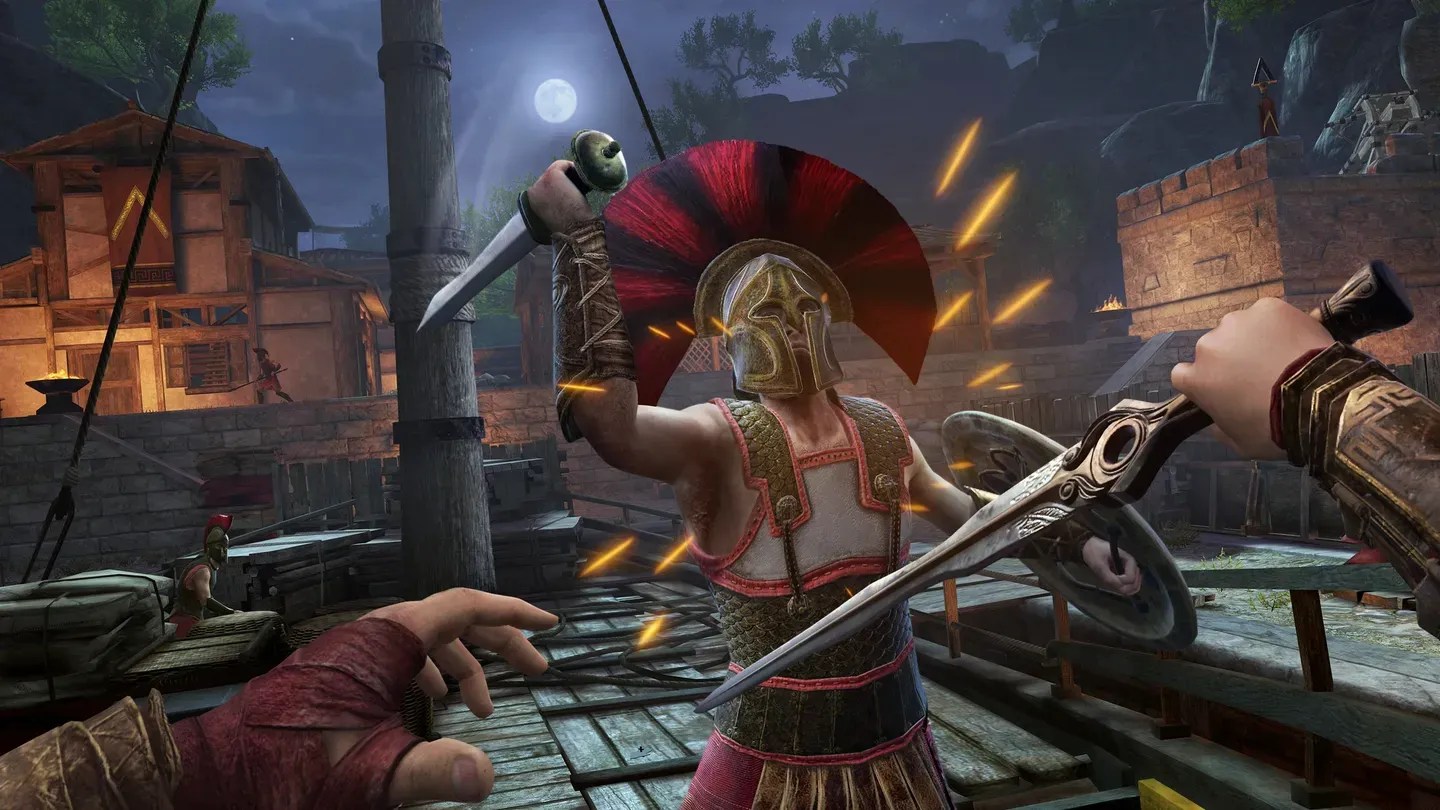
Stealth is the more natural fit for VR than direct sword fighting. Hiding in crowds, throwing objects to distract guards, approaching from above, and snapping out the hidden blade all match the headset’s strengths because they reward presence, timing, and body position. Those are moments where Nexus VR feels like it understands the fantasy.
Combat is more divisive. Reviews and player impressions generally respect the ambition, but some criticism clusters around melee feel, timing, and the occasional awkwardness of physical duels. That does not ruin the game, but it matters for buyer expectations. If you want perfect sword simulation, this is not Blade & Sorcery. If you want Assassin’s Creed systems expressed through VR, combat is part of the package rather than the only reason to play.
Community and Review Signals
Meta currently shows a 4.3 out of 5 rating from about 5,422 ratings. VRDB tracks the game as Very Positive, with roughly 5.3K ratings and a $39.99 U.S. price snapshot. Review coverage has been mixed-positive in a useful way: WIRED praised how it makes the Assassin’s Creed fantasy feel embodied, while TechRadar called out strong maps, comfort options, and fan appeal alongside frustrations with combat and the feeling that it plays like a supplemental spin-off rather than a full mainline reinvention.
That is actually a helpful signal. Nexus VR is not a universal safe pick. It is a strong targeted pick. Fans who want to stand inside Assassin’s Creed are likely to get more from it than players who simply want the most mechanically polished VR melee game. The more you care about the franchise’s movement, stealth, and historical atmosphere, the more sense it makes.
Price and Value
At about $39.99, Nexus VR sits in premium Quest territory. The value case depends on what you want from the headset. If you want a recognizable franchise with a real campaign structure and plenty of physical interaction, the price is defensible. If you only want endlessly replayable multiplayer, fitness, or sandbox mods, that same price looks less automatic.
The best buyer is someone who wants a substantial single-player VR adventure and already likes the Assassin’s Creed language: climbing, scouting, stealth, lore, and dramatic movement. For that person, Nexus VR fills a different library slot than Resident Evil 4 VR, Demeo, Gorilla Tag, or Walkabout Mini Golf. It is not social comfort food. It is franchise fantasy with arms.
Who Should Buy It
Buy Assassin’s Creed Nexus VR if you have ever wanted to perform a Leap of Faith from inside the body, if you like stealth routes more than loud firefights, or if you want a Quest game that makes a famous console franchise feel native to VR rather than pasted onto a headset. It is also a strong pick for players who want more physical movement without turning the session into pure fitness.
It is especially easy to recommend to Assassin’s Creed fans who already own a Quest 3 or Quest 3S. You will notice compromises, but the thrill of embodying Ezio, Kassandra, and Connor gives the game a kind of fan-service gravity that most generic VR action games cannot copy.
Who Should Wait
Wait if you are very sensitive to artificial movement, if you dislike climbing in VR, or if you need combat to feel perfectly weighted. Also wait if you are not attached to Assassin’s Creed as a setting or fantasy. Without that attachment, the game’s rough edges become louder.
Parents should note the Teen rating and the action-combat focus. It is less grim than Resident Evil 4 VR, but it is still a stealth-action game about assassination, weapons, and historical conflict.
Official Store Page
Use the official Meta Quest store page to confirm live U.S. price, supported headsets, current rating, comfort details, age rating, file information, and sale timing before buying.
Official Video
The official Meta Quest launch trailer is the quickest visual check. It shows the core promise clearly: parkour, stealth, combat, Ezio, Kassandra, Connor, and the fantasy of becoming an Assassin in first person.
Final Recommendation
Assassin’s Creed Nexus VR is worth recommending as a premium Meta Quest app because it does something specific: it turns one of gaming’s clearest movement fantasies into a body-first VR experience. The best parts are not abstract. They are the reach for a ledge, the quiet approach from above, the hidden blade motion, the crowd blend, and the drop.
My recommendation is strongest for franchise fans and single-player Quest owners who want scale. It is not the cleanest combat game and not the safest first VR purchase. But if the idea of becoming Ezio, Kassandra, or Connor still makes your brain light up a little, Nexus VR remains one of the most interesting big-name adventures on Meta Quest.
If today's VR stories push you closer to jumping in, this Meta Quest referral can still give you a $30 credit on an eligible headset purchase.
Continue Reading
Stay in the VR guide loop with these related PlayTechDeep articles.
- Skydance’s BEHEMOTH on Meta Quest: Giant Boss Fights, Brutal Melee, and a Premium VR FantasySkydance’s BEHEMOTH on Meta Quest: a U.S.-focused app guide covering price, giant boss fights, brutal melee…
- Ancient Dungeon on Meta Quest: A Co-Op Roguelite Dungeon Crawler With Real VR HandsAncient Dungeon on Meta Quest: a U.S.-focused app guide covering price, co-op roguelite dungeon crawling…
- Marvel’s Iron Man VR on Meta Quest: Is Flying as Tony Stark Still Worth It?Marvel’s Iron Man VR on Meta Quest: a U.S.-focused app guide covering price, flight combat, Tony Stark story…
- Until You Fall on Meta Quest: A Neon Sword-Fighting Roguelite That Still Hits HardUntil You Fall on Meta Quest: a U.S.-focused app guide covering price, neon sword combat, roguelite runs…
Sources
- Official Meta Quest store page
- Official Ubisoft Assassin's Creed Nexus VR page
- Ubisoft developer interview on how Nexus VR was built
- VRDB price, rating, device, comfort, and public store snapshot
- UploadVR gameplay trailer and mechanics coverage
- TechRadar review and comfort/combat impressions
- WIRED review and immersion analysis