
Buy the Version That Has the Features
Cubism’s official FAQ confirms 90 puzzles across two volumes, plus a local puzzle editor. It also confirms hand tracking and mixed reality only in the standalone Meta Quest version, making the edition choice important for buyers who want those features.
Choose standalone Quest if hand tracking or mixed reality matters to you. Cubism states that these features are not available in PCVR, including when a Quest headset is connected through Link, so PCVR buyers should not expect feature parity.
Cubism is the Meta Quest puzzle app I recommend when someone wants the cleanest possible version of spatial thinking in VR. No monsters, no story pressure, no cluttered interface, no fake urgency. Just colored blocks, a target shape, quiet piano, and the oddly satisfying moment when a piece finally turns the right way.
Meta Quest referral
If you use this link when buying a Meta Quest headset, you can receive a $30 store credit. Only use it if it feels useful.
Quick Buyer Snapshot
- Genre: VR spatial puzzle, logic puzzle, minimalist brain teaser, Mixed Reality tabletop puzzle, and hand-tracking showcase.
- Developer: Thomas Van Bouwel.
- Publisher: Vanbo LLC / Creature Label, depending on platform listing.
- U.S. price context: Check the official Meta store for the current U.S. price; sale prices vary.
- Best for: players who want calm puzzle solving, hand tracking, passthrough Mixed Reality, short sessions, spatial reasoning, and a beginner-friendly app that still gets difficult.
- Play mode: VRDB lists Single User.
- Player modes: VRDB lists Sitting, Standing, and Room Scale support.
- Comfort context: VRDB lists Comfortable.
- Mixed Reality: VRDB lists Mixed Reality support.
- Headset support: Meta lists support for Quest 2, Quest Pro, Quest 3, Quest 3S, Quest.
Why Cubism Still Feels Modern
Cubism still feels modern because it was built around clarity from the start. The official site describes it as a deceptively simple VR puzzle game where you assemble increasingly complex shapes out of colored blocks. The press kit says the game has 90 puzzles across two volumes, supports hand tracking and passthrough AR on standalone Quest, includes a local puzzle editor, and was designed so players can learn the core mechanic within the first 10 to 30 seconds.
That is excellent VR design discipline. Many apps add friction and then call it depth. Cubism removes friction so the actual puzzle can become the difficulty.
How It Plays on Quest
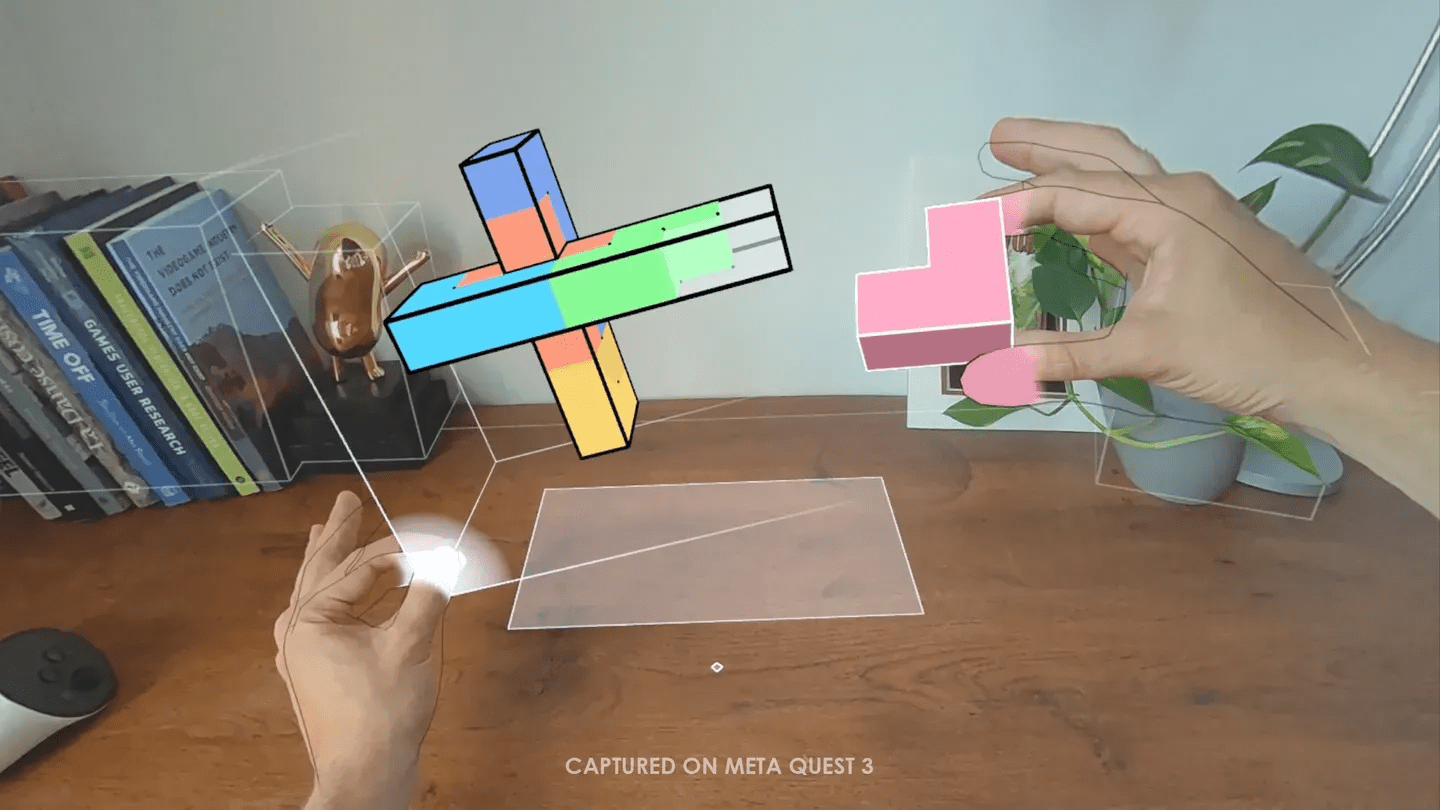
Each puzzle gives you a target volume and a set of colored blocks. You rotate pieces, place them into the form, pull them out, reconsider the shape, and keep adjusting until everything fits. The rules are obvious, but the later puzzles demand real spatial reasoning.
The game works because the hand motion matches the mental task. You are not controlling a cursor that represents a block. You are grabbing, turning, and fitting the block as if it were a physical puzzle on a table. That small difference is exactly why VR matters here.
Mixed Reality Might Be the Best Way to Play
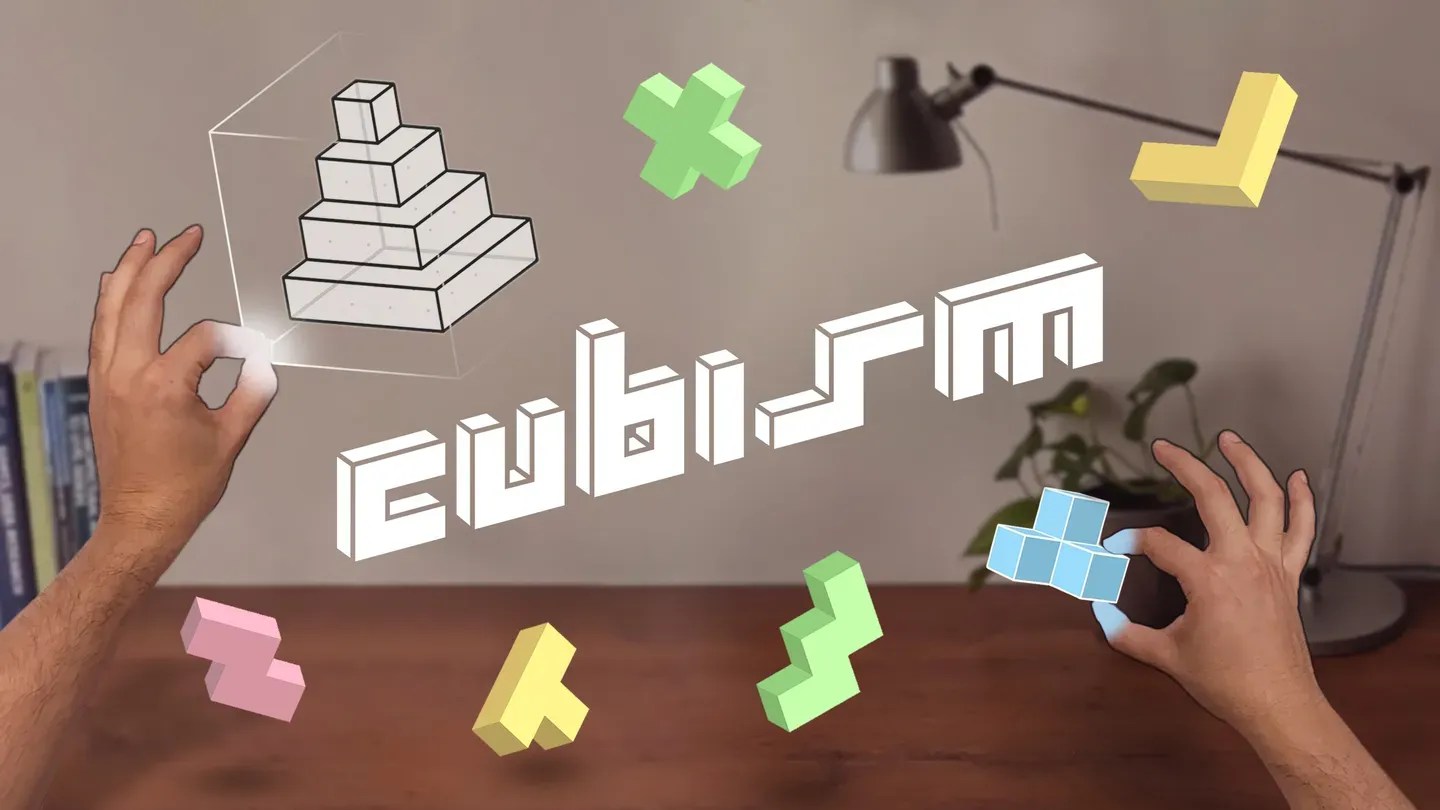
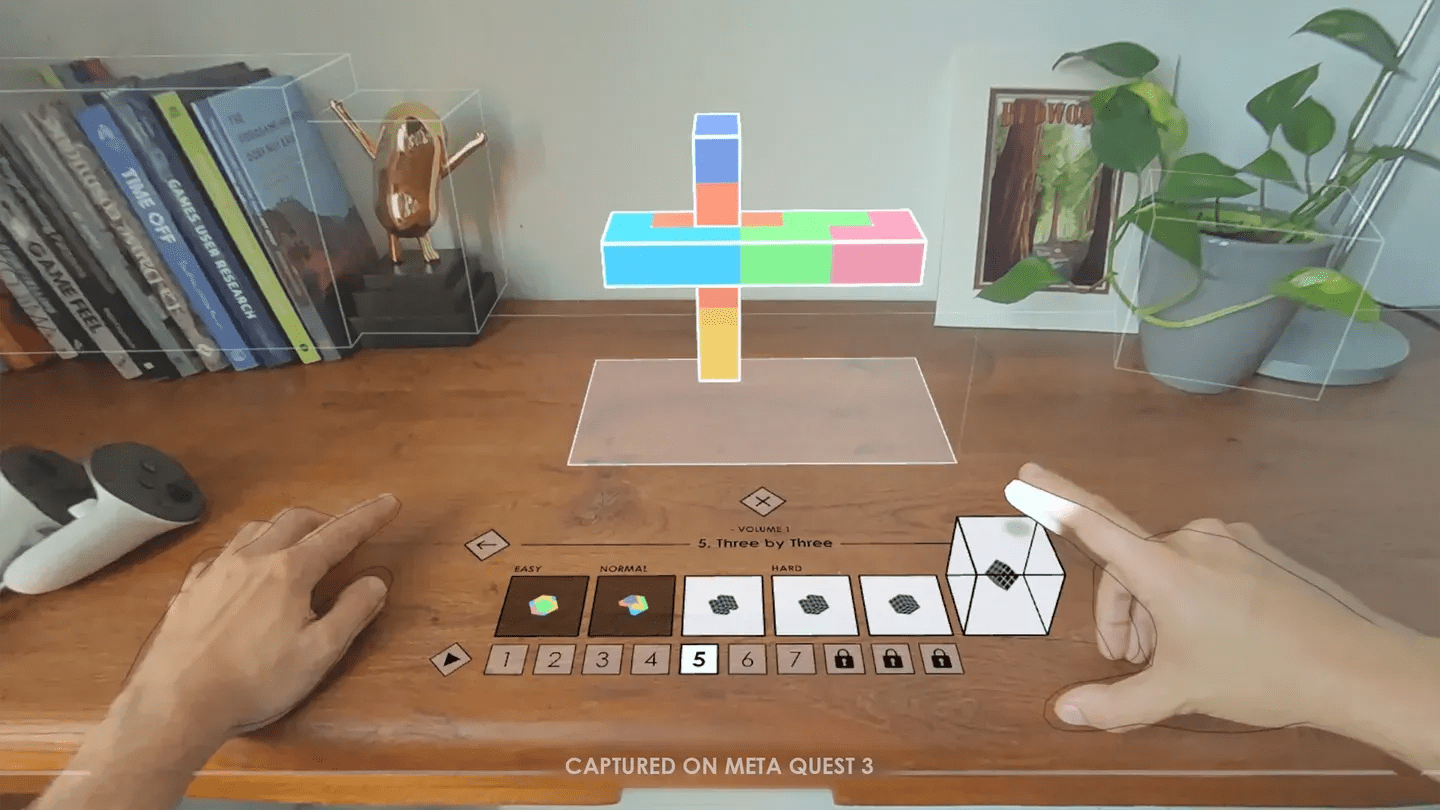
Cubism’s Mixed Reality support is more than a checkbox. The puzzle naturally wants to live on a table, desk, or floor in front of you. Passthrough makes that feel obvious. Instead of being transported to a huge fantasy space, you bring the puzzle into your room.
That is a smart use of Quest hardware. Mixed Reality often feels forced when the app is secretly a normal VR game. Cubism does not have that problem. Its clean blocks and tabletop structure are already compatible with the real room.
Hand Tracking Fits the Mood
Cubism has long been discussed as one of Quest’s better hand-tracking examples. UploadVR previously covered the developer’s work on hand-tracking improvements, including a force-like way to summon pieces that are just out of reach. The official site also highlights hand tracking as a beginner-friendly Meta Quest feature.
Hand tracking is not automatically better for every game. For Cubism, it fits because the pace is calm and deliberate. A tiny tracking mistake is less punishing than it would be in an action game, and using bare hands makes the puzzle feel more like a real object.
The Minimal Look Is the Point
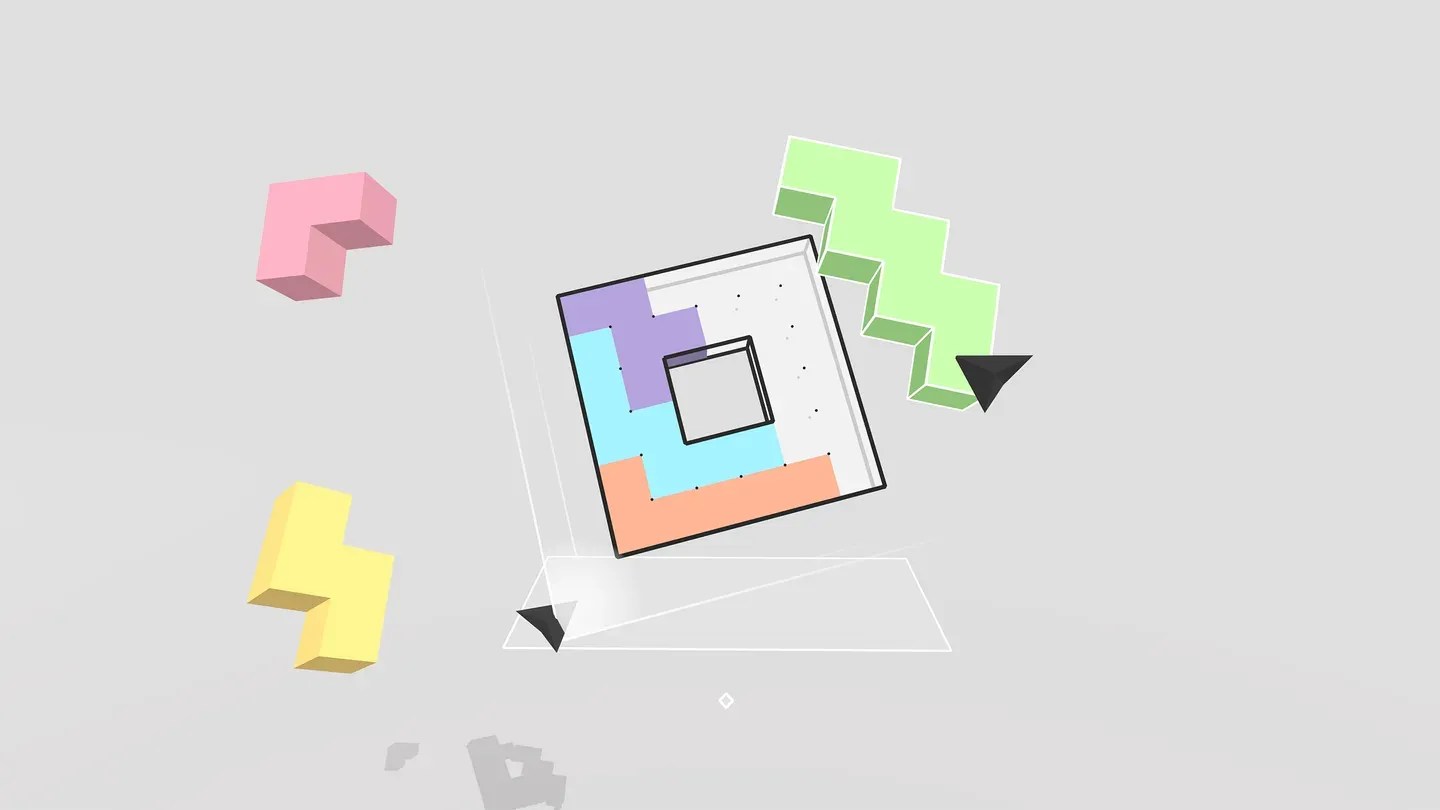
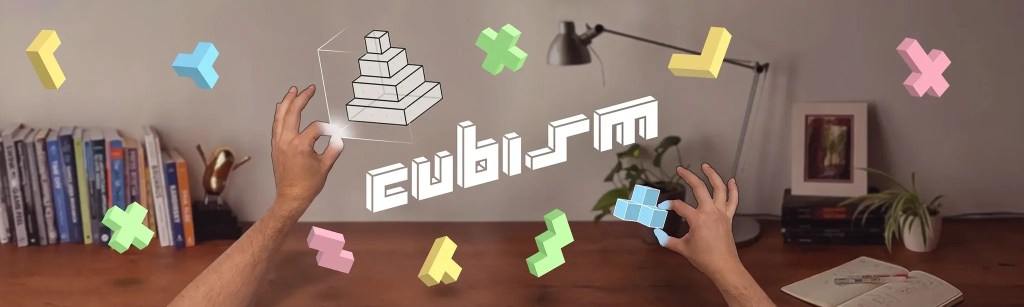
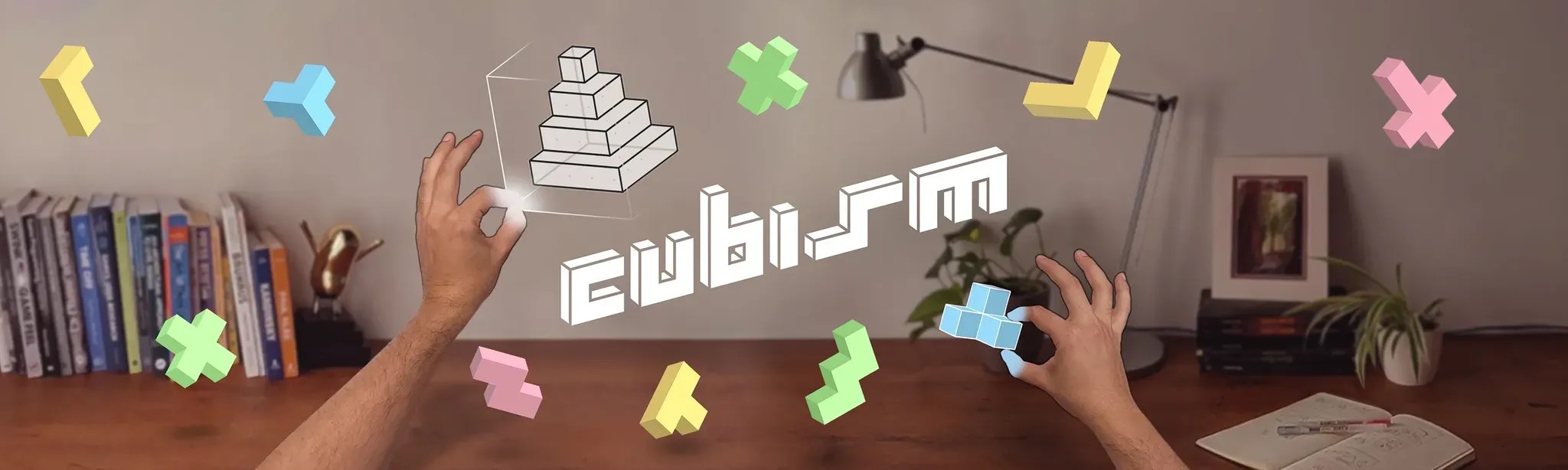
Cubism looks simple because it should. The white space, pastel blocks, clean edges, and soft soundtrack keep the player’s attention on rotation, volume, and fit. There is no visual noise competing with the shape.
That design also makes it unusually approachable. A player who is intimidated by combat games or dense VR menus can understand Cubism quickly. But approachable does not mean shallow. Later puzzles can be stubborn in exactly the right way.
The Puzzle Editor Adds Long-Term Value
The local puzzle editor is an important part of the value story. UploadVR reported on the level editor update in 2022, noting that it works on Quest or Steam and supports controllers or hand tracking, with puzzles saved locally. The official press kit also says Cubism supports sideloading custom puzzles and color themes, with a built-in local editor as of version 1.6.0.
That does not turn Cubism into a huge online creation platform, but it does give curious players something beyond the built-in campaign. For a compact puzzle app, that extra creative layer is meaningful.
Price, Rating, and Community Signals
Earlier store snapshots showed a 4.8 out of 5 rating from about 1,098 ratings. The same earlier VRDB snapshot listed a $9.99 U.S. price, a 4.8-star Very Positive Quest rating from about 1.1K verified-owner ratings, Comfortable comfort, Single User mode, and Mixed Reality support. That earlier Steam snapshot listed the game at $9.99 with Positive sentiment, and the press-kit price cited at the time was $9.99; check the linked storefront for today’s price.
Those are unusually clean signals. Cubism is inexpensive, highly rated, easy to explain, and has continued receiving updates. UploadVR’s 2025 anniversary coverage also notes new soundtrack songs, improved Mixed Reality menu readability, new languages, and engine/rendering pipeline updates intended to future-proof the app.
What It Does Better Than Many Puzzle Apps
Cubism understands that a VR puzzle does not need to be big to be spatial. Its challenge is not hidden behind adventure-game logic or item combinations. The challenge is the shape itself. That makes it excellent for readers who like puzzles but dislike wandering around looking for the next interactable object.
It also makes the headset feel calm. Not every Quest app should spike adrenaline. Cubism is a reason to sit down, think, rotate one piece for far too long, and then feel very smug when it clicks.
Where It May Disappoint
Cubism may disappoint players who want story, spectacle, combat, multiplayer, or a dramatic progression system. It is pure puzzle design. If you do not enjoy spatial reasoning, the clean presentation will not save it.
It may also feel too small next to premium Quest releases. That is fair. Cubism is a compact app, but it is priced and designed like one. The question is not whether it has blockbuster scale. The question is whether you want a polished spatial puzzle tool that respects your time.
Who Should Buy It
Buy Cubism if you want a calm, clever, highly rated Quest puzzle game that works well with controllers, hand tracking, and Mixed Reality. It is a strong fit for puzzle fans, new VR users, classrooms, families, and anyone who wants an app that shows off Quest’s tabletop MR side without noise.
It is also a good contrast pick for a library full of shooters and action games. Sometimes the best next app is not louder. Sometimes it is quieter and better made.
Who Should Wait
Wait if you need story, movement, social play, or action. Also wait if you dislike abstract puzzles. Cubism is honest about what it is: colored blocks, spatial logic, clean interaction, and increasing difficulty.
If that sentence sounds relaxing instead of boring, this is an easy recommendation.
Official Store Page
Use the official Meta Quest store page to confirm live U.S. pricing, headset support, comfort details, hand tracking, Mixed Reality support, current rating, and sale timing before buying.
Official Video
The Meta Quest Mixed Reality trailer shows why Cubism fits passthrough so well: the puzzle becomes a clean object in your real room, not a noisy virtual stage.
Final Recommendation
Cubism is worth recommending because it is one of the cleanest small puzzle apps on Meta Quest. It understands its idea, trims everything around it, and lets the interaction carry the experience.
My recommendation is strongest for puzzle players, MR-curious Quest owners, and anyone who wants a calm app with excellent hand presence. Buy it if you want a compact brain teaser that still feels designed for VR. Skip it if you need action or spectacle. Cubism is quiet. That is why it works.
If today's VR stories push you closer to jumping in, this Meta Quest referral can still give you a $30 credit on an eligible headset purchase.
Continue Reading
Stay in the VR guide loop with these related PlayTechDeep articles.
- The Curious Tale of the Stolen Pets on Meta Quest: A Tiny Diorama Puzzle Game for Calm VR SessionsThe Curious Tale of the Stolen Pets on Meta Quest: a U.S.-focused app guide covering price, cozy diorama…
- Ghost Giant on Meta Quest: A Small Diorama Story About Helping Someone Feel Less AloneGhost Giant on Meta Quest: a U.S.-focused app guide covering price, diorama story, Louis, puzzles, comfort…
- Down the Rabbit Hole on Meta Quest: A Wonderland Diorama Adventure That Still Feels MagicalDown the Rabbit Hole on Meta Quest: a U.S.-focused app guide covering price, Wonderland diorama adventure…
- Tentacular on Meta Quest: A Weirdly Sweet Physics Puzzle Game With Giant Wobbly TentaclesTentacular on Meta Quest: a U.S.-focused app guide covering price, physics puzzles, giant tentacles, sandbox…